HomeArize
Discover how flooring companies can use SEO, Google Maps, and local search strategies to attract more customers and grow their flooring business.
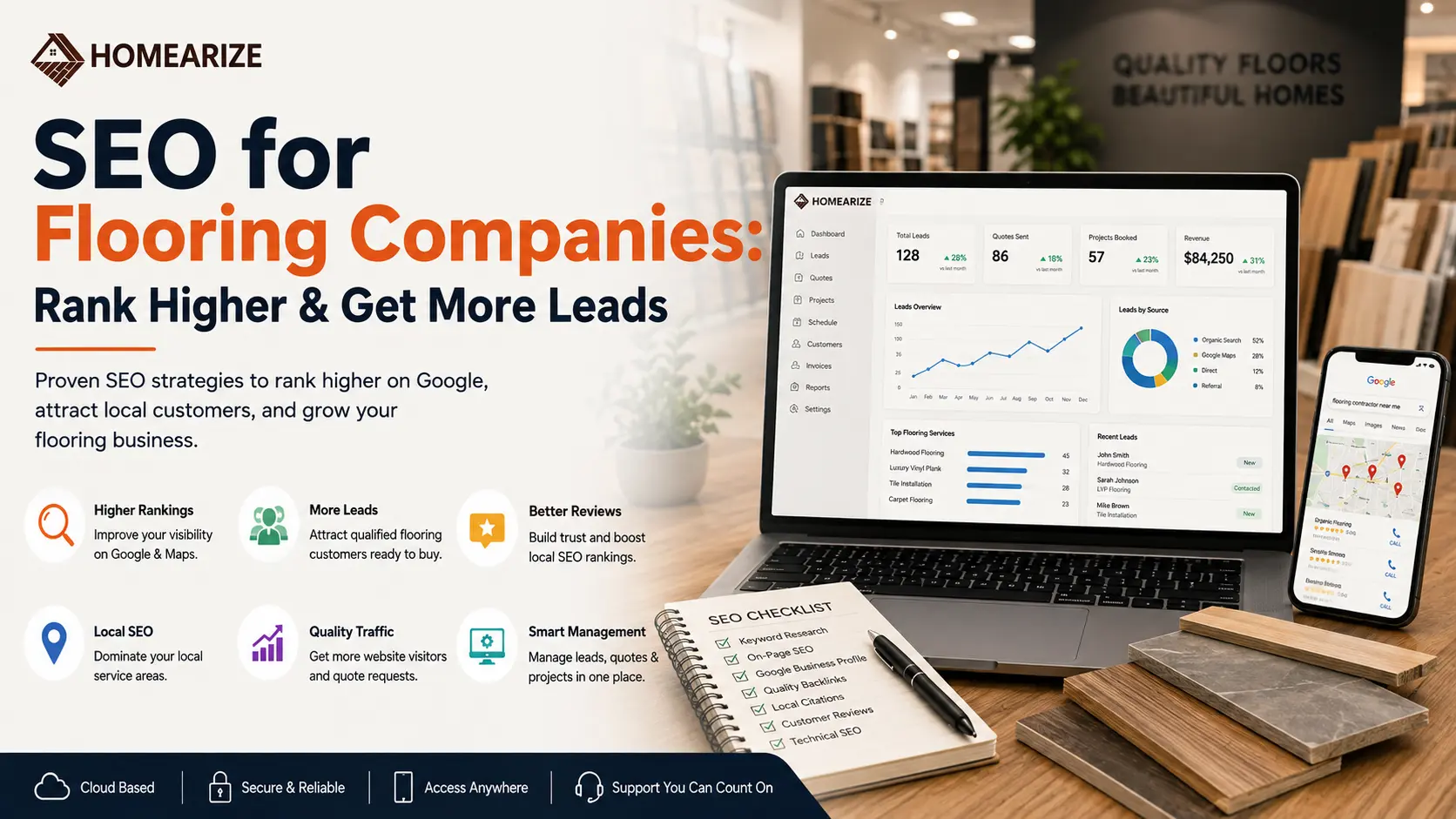
SEO for Flooring Companies: Complete Guide to Getting More Leads from Google
The New Reality of Flooring Lead Generation
Flooring customers no longer flip through directories or wait for a weekend newspaper insert. Today, they open a browser, search for inspiration on image-heavy platforms, and submit a quote request before ever speaking to a salesperson.
SEO for flooring companies has moved from a nice-to-have to the primary engine driving showroom traffic and installation bookings.
Consumer search behavior has changed significantly in recent years. Most homeowners begin their flooring journey with a Google search, comparing local companies, reading customer reviews, and exploring project galleries before requesting an estimate. This makes search visibility a critical factor in generating consistent, high-quality leads.
Flooring is also uniquely visual. Shoppers browse room inspiration images, compare wood tones and tile patterns, and only then search for a local installer - making the path from search result to showroom appointment tighter and more intent-driven than most home services categories. That pipeline, from first search impression to in-store consultation, is what this guide calls the Search-to-Showroom pipeline.
Understanding the terminology behind that pipeline is where strategy begins.
Core Flooring SEO Terminology
Before you can execute a winning flooring company SEO strategy, you need a shared vocabulary. The concepts below form the technical foundation for everything that follows in this guide.
Local 3-Pack
The top three map-based business listings Google displays for location-specific queries - the most competitive and highest-converting real estate in local search.
NAP Consistency
The synchronization of your business Name, Address, and Phone number across every online directory, citation, and platform - a foundational ranking factor that establishes trust with Google's algorithm.
Long-Tail Keywords
Specific, intent-rich phrases such as "hardwood floor installation near me" or "waterproof LVP flooring contractor Austin" that signal a buyer ready to act, not just browse.
Back-Office Integration
The connection between inbound SEO leads and your ERP or CRM system, enabling accurate quote tracking and true return-on-investment measurement from organic traffic.
NAP inconsistency alone can suppress your rankings regardless of how strong your content is. Even a single mismatched suite number across directories creates conflicting signals. Understanding these terms precisely sets the stage for the highest-leverage local tactic available to flooring businesses: dominating the Google Map Pack.
Dominating the Google Map Pack
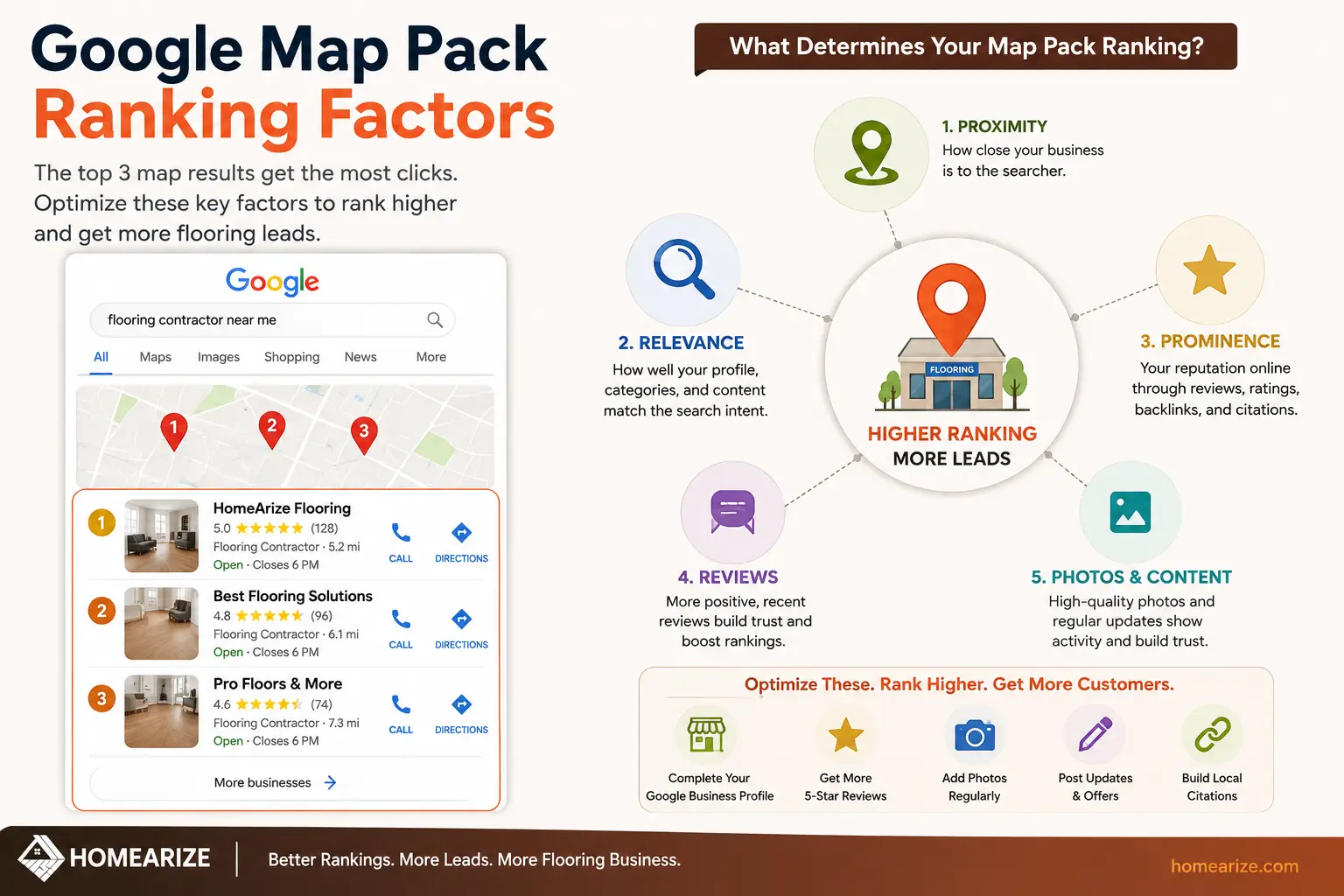
For flooring companies, the Google Map Pack is the single most valuable piece of digital real estate available. When a homeowner searches "hardwood floor installation near me," the three businesses displayed in that map cluster capture the overwhelming majority of attention - before a single organic result gets a look.
The numbers make the case plainly: Map Pack results capture 42% of all clicks for local search queries. For flooring SEO, that concentration of clicks means ranking in the top three map positions is often worth more than landing on the first page of organic results.
Three core factors determine your Map Pack position:
Proximity
how close your business address is to the searcher at the moment of the query
Relevance
how precisely your profile, categories, and content match the search intent
Prominence
the weight of your reviews, citations, backlinks, and overall online authority
Mobile crews present a specific challenge here. Setting your service area correctly in your profile - listing every city and zip code your installers actually reach - signals relevance beyond your physical address and prevents you from being invisible in the suburbs you serve daily.
And once you understand what drives Map Pack placement, the next logical question becomes: how do you actively build and maintain that prominence? That answer starts with your Google Business Profile.
Optimizing Your Google Business Profile (GBP)
A fully optimized
Google Business Profile is one of the highest-leverage flooring lead generation tools available - and most flooring companies underuse it. As established in the Map Pack section, your GBP is what triggers that coveted three-pack placement. But winning the placement is only half the battle; converting profile visitors into calls requires deliberate, ongoing optimization.
Follow this checklist to maximize your GBP performance:
Upload daily project photos.
Visual proof builds instant trust. Google Business Profiles with high-quality photos receive 42% more direction requests and 35% more website click-throughs. Post before-and-after shots of each completed installation - hardwood, tile, LVP - to signal both quality and service breadth.
Use GBP Posts for seasonal promotions.
Announce spring sales, end-of-year specials, or new product lines directly on your profile. Posts keep your listing active and signal relevance to Google.
Respond to every review.
Replying to positive reviews reinforces trust; addressing negative ones publicly demonstrates professionalism. Both behaviors influence ranking.
Select the correct business category.
"Flooring Contractor" and "Flooring Store" send different intent signals. Choose the primary category that matches your core revenue model, then add secondary categories to capture additional searches.
And because reviews are so tightly woven into GBP performance, the next step is building a systematic approach to generating them consistently.
The Power of Recent Reviews
Review velocity is one of the most underrated ranking signals in local SEO for home services - and flooring companies that ignore it are leaving leads on the table.
As covered in the previous section, your Google Business Profile needs consistent activity to stay competitive. Nothing signals activity more clearly to Google's algorithm than a steady stream of fresh reviews.
"A flooring company with 80 recent five-star reviews will outperform a competitor with 20 older reviews, even with a smaller website budget."
Four Arrows Marketing
Recency matters as much as volume. A burst of reviews from two years ago carries far less weight than reviews posted last month. Google interprets recent reviews as proof that a business is actively serving customers - a trust signal that directly influences Map Pack rankings.
Automating review requests post-installation tends to work better than manual follow-up. A simple text message sent within 24 hours of job completion, with a direct link to your GBP review page, consistently drives higher response rates.
And do not overlook what customers actually write. When a homeowner naturally mentions "hardwood refinishing" or "tile installation" in their review, those keywords reinforce your service relevance to Google. Encouraging your installation crews to prompt specific feedback - "Tell them exactly what floor type we installed" - builds that keyword-rich review content organically.
That same installation team is your most powerful review-generation asset. Building a review culture starts on the job site. When technicians understand how reviews directly affect the company's visibility and their own job security, participation increases dramatically.
Once your review profile is strong, the next lever is your website itself - specifically, how well each service page and local landing page is optimized to convert that search traffic.
On-Page SEO for Flooring Websites
Your website's architecture is the foundation of local search dominance - and every missing service page is a lead you are sending to a competitor.
Google prioritizes websites that have specific, high-quality content for every service a business claims to offer. That means a single "Services" page listing hardwood, laminate, vinyl, and tile installation is not enough. Each flooring type deserves its own dedicated page, optimized around distinct buyer intent and terminology.
Beyond service pages, local landing pages multiply your visibility across your entire service radius. A homeowner searching "flooring contractor near me" in a neighboring city will rarely find your homepage - but a well-built city-specific page can rank directly for that search. Build one for every city or zip code you actively serve, each with localized content that reflects real knowledge of that area.
| Service Page Type | Target Keyword | Content Goal |
|---|
| Hardwood Installation | hardwood floor installation [city] | Educate on wood species, cost, process |
| Vinyl Plank Flooring | LVP flooring contractor [city] | Address durability and moisture concerns |
| Tile Installation | tile floor installation near me | Showcase pattern options and grout choices |
| Local Landing Page | flooring contractor [city name] | Capture geo-specific "near me" intent |
Site speed and mobile responsiveness are non-negotiable. Most homeowners request on-site estimates directly from their phones, and a slow-loading page will cost you the conversion before it ever starts. These technical foundations set the stage for the content strategy - particularly the educational resources and cost guides - covered in the next section.
Content Marketing: Showcasing Expertise
Content marketing is the bridge between a flooring company's technical SEO foundation and the trust that converts a curious visitor into a booked consultation.
Building that trust starts with answering the questions your customers are already searching. Educational content - such as a detailed "Hardwood vs. Luxury Vinyl Plank" comparison guide - builds authority while keeping users on-site longer, sending engagement signals that reinforce your local rankings.
Educate: Top-of-funnel content captures early-stage buyers who are still researching:
Cost guides targeting searches like "how much does hardwood flooring cost" pull in high-intent visitors before competitors enter the conversation
Room-specific guides (basement flooring options, pet-friendly floors) address specific pain points naturally
Compare: Mid-funnel content narrows the decision:
Before-and-after case studies function as both social proof and keyword-rich project pages
FAQ content structured around common objections wins Featured Snippets, placing your answer above all organic results
Convert: Bottom-of-funnel content closes the gap:
Every blog post should link internally to a relevant service or product page, channeling accumulated authority where it drives leads
Syndicating content highlights back to your Google Business Profile for flooring extends reach across the local search ecosystem
And none of this content works in isolation - the technical infrastructure underneath it determines how well Google can discover, index, and rank every page you publish.
The Technical SEO Checklist for Flooring Retailers
Technical SEO is the infrastructure layer that determines whether your content and local strategy actually get indexed, understood, and ranked by Google.
With your on-page foundations and content strategy already in place, these four technical elements are the highest-leverage items remaining - each one quietly affecting how Google crawls and interprets your flooring website.
Schema Markup for Local Business and Aggregate Rating
Structured data tells Google exactly what your business is, where it operates, and what customers think of it. As Google Search Central confirms, Local Business Schema helps Google understand your physical location and service hours more accurately - and Aggregate Rating Schema surfaces star ratings directly in search results, boosting click-through rates before a visitor ever reaches your site.
Image Alt Text for Project Galleries
Every photo in your hardwood installation or luxury vinyl tile gallery is a missed ranking opportunity without descriptive alt text. Write alt text that includes the flooring type, material, and location (example: "herringbone oak hardwood installation in Austin TX showroom").
XML Sitemap Submission to Search Console
Submitting a current XML sitemap ensures Google discovers every service page and location page without relying on crawl paths. Resubmit whenever you add new showroom or product category pages.
Internal Linking Structure for Showroom Locations
Linking your homepage and service pages directly to individual showroom location pages distributes authority and helps Google treat each location as a distinct, rankable entity. This tends to work better than orphaned location pages with no inbound internal links.
Getting these technical elements right transforms your site from one Google occasionally visits to one it actively prioritizes - and that prioritization is what ultimately fills your quote request forms. The next step is making sure those forms, and every other lead touchpoint, are captured and managed effectively.
Managing the Leads: From Click to Contract
SEO without a lead management system is like turning on a faucet with no bucket underneath - traffic arrives, but revenue slips away.
Strong technical SEO and compelling content will drive qualified visitors to your site. But what happens after the form submission determines whether that investment pays off. A slow follow-up, a missed inquiry, or a lead logged in a spreadsheet instead of a system means lost revenue regardless of how well you rank.
Disconnected lead management is one of the most common reasons flooring companies fail to see ROI from organic traffic. HomeArize addresses this directly by allowing flooring companies to consolidate leads from digital sources into a cloud-based ERP for faster scheduling, tighter quoting workflows, and cleaner attribution data.
Tracking where each lead originates - organic search, paid ads, or referral - lets you calculate the true cost per acquisition for SEO versus other channels. That data justifies continued investment and reveals which service pages actually drive booked jobs, not just clicks.
As organic traffic scales, operational bottlenecks become the real growth ceiling. Automating intake, scheduling, and follow-up ensures your team handles more volume without proportional headcount increases. If you still have questions about how long this process takes or which tactics deliver results fastest, the next section addresses the most common questions flooring businesses ask before committing to SEO.
Key Takeaways for Flooring Growth
A flooring business that pairs local visibility with operational software grows faster than one that treats marketing and management as separate concerns.
The sections above cover a wide range of strategy, but a handful of principles consistently separate high-performing flooring retailers from the rest. Use this as your quick-reference summary before moving into the final steps.
Prioritize the Map Pack first.
Your Google Business Profile and consistent photo uploads are the single highest-leverage actions for capturing local buyers who are ready to purchase.
Review recency beats review volume.
A steady stream of recent reviews often outranks a competitor with twice as many older ones. Build a repeatable review-request process into every completed job.
Optimize for digital form submissions.
Modern flooring buyers expect to request quotes online. A frictionless form - short, mobile-friendly, above the fold - directly increases conversion rates from organic traffic.
Connect marketing to operations.
Routing leads into an ERP like HomeArize ensures every inquiry is tracked, followed up, and converted - turning visibility into measurable revenue.
A unified strategy of local visibility and operational software is the fastest path to scaling a flooring business. With these foundations in place, the final step is mapping your next moves.
Conclusion: Building Your Flooring Empire
SEO for flooring companies is not a campaign - it is a compounding asset that grows more valuable the longer you invest in it. Every optimized Google Business Profile, every localized service page, and every five-star review you earn adds another layer to a digital showroom that works around the clock, converting searchers into scheduled estimates.
The retailers who dominate local search share a common trait: they show up as the obvious expert before a prospect ever visits a showroom. That visibility is a competitive advantage that compounds over time and becomes increasingly difficult for slower-moving competitors to close.
Your next step is clear. Start with an honest audit of your Google Business Profile, then evaluate whether your lead management process can handle the volume that better visibility will generate. As
HomeArize puts it, "The best flooring software helps you grow efficiently by keeping back-office operations in sync with your sales growth."
Book a HomeArize demo and put that infrastructure in place before your next lead arrives.
Highlights
- Improve Google rankings with local SEO, Google Business Profile optimization, and targeted flooring keywords.
- Build long-term organic traffic through helpful content, technical SEO, and customer reviews.
- Convert more website visitors into customers by combining SEO with HomeArize's CRM, estimating, and scheduling tools.
FAQs
How long does it take to see results from flooring SEO?
Most flooring businesses notice meaningful movement in local rankings within three to six months of consistent effort. Competitive markets may take closer to nine to twelve months before you see significant lead volume increases.
Do I need a separate page for every flooring type?
Yes. Dedicated pages for hardwood, luxury vinyl plank, tile, and carpet allow Google to match your content precisely to buyer intent. A single general page dilutes your relevance across all categories.
How do I get more Google reviews from my customers?
Send a direct review link via text message immediately after installation. Timing matters - requests sent within 24 hours of project completion generate far higher response rates.
Is SEO better than paid lead generation?
SEO delivers long-term organic leads and builds trust, while paid advertising provides quicker results. For most flooring companies, combining both strategies offers the best return on investment.
What is the most important ranking factor for flooring contractors?
Your Google Business Profile, supported by consistent NAP citations and recent reviews, remains the single most powerful lever for local visibility - a theme the key takeaways ahead will reinforce directly.
Tags:
SEO for flooring companiesFlooring SEOFlooring company SEOSEO for flooring contractorsLocal SEO for flooring companiesFlooring lead generationFlooring marketing strategiesGoogle Business ProfileGoogle Maps SEOFlooring business marketing