HomeArize
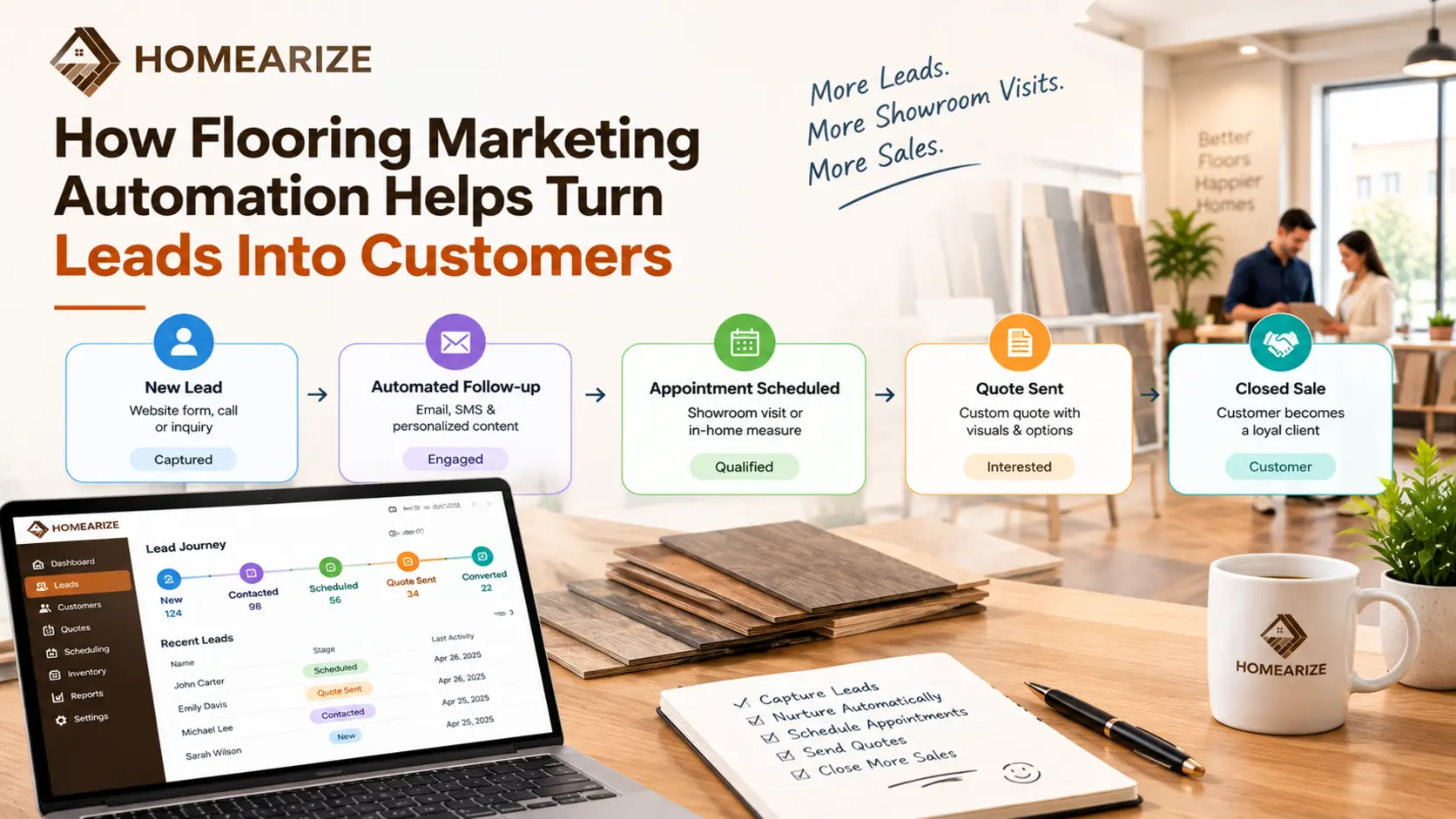
How flooring marketing automation supports consistent lead follow-up, keeps prospects engaged, and connects marketing activity with the sales process.
How Flooring Marketing Automation Helps Turn Leads Into Customers
A flooring salesperson quotes a job on Tuesday. By Friday, the customer still hasn't heard back, so they call a competitor instead. The quote wasn't the problem. The silence after it was. Flooring marketing automation exists mainly to close that specific gap, the stretch of time between a promising first contact and an actual booked job, where a lot of otherwise winnable leads quietly disappear.
Here's what this article actually covers: how automation keeps follow-up consistent, how to treat leads differently depending on where they are in the process, and why marketing outreach and the sales conversation need to run off the same information instead of two separate lists.
Why Flooring Businesses Need Consistent Follow-Up After Receiving a Lead
Few people buy flooring on the spot. Someone comparing samples in a showroom, or filling out a contact form at 9pm, is almost always weighing more than one option, and they usually need a nudge or two before committing to anything. If that nudge depends on a salesperson remembering to circle back between job sites and other calls, some leads simply fall off the list. Not because they weren't interested. Because nobody got back to them in time.
Timing tends to matter more than persistence here. A lead who hasn't heard anything in a week has often already moved on to whichever company did respond, regardless of how strong the original interest was.
How Marketing Automation Organizes and Supports Lead Follow-Up
In practice, marketing automation just means the follow-up schedule stops living entirely in someone's head. A lead goes quiet for three days and gets flagged automatically. A quote that never got a response triggers a scheduled check-in. A promotional update reaches everyone who inquired last quarter without someone manually assembling that list from memory.
An actual conversation with the lead still has to happen eventually, automation doesn't replace that part. What changes is the odds that the conversation gets scheduled in the first place, rather than quietly falling through because the week got busy, which happens often enough to cost real business.
Moving Leads Through Different Stages of the Sales Journey
Someone who submitted an inquiry an hour ago needs something different from someone who received a quote three weeks ago and went silent. Treating those two situations the same way, with the same generic message, wastes the opportunity in both directions.
A fresh inquiry usually calls for a fast, direct response. A pending quote does better with a gentle check-in than a hard push. A stalled decision often needs a new reason to reconsider, different pricing, a new material option, a seasonal angle, rather than a repeat of the exact message that already went unanswered once.
Using Lead Information to Make Follow-Up More Relevant
Follow-up lands differently when it references what a lead actually said: the material they liked, the room they were measuring, the timeline they mentioned. A message built on those specifics reads like it came from a person paying attention, not a mail merge. Getting there depends on the underlying customer record staying accurate and current, which is more of a CRM job than a marketing one. See the
Complete Flooring CRM Guide for how that record-keeping should actually work.
Re-Engaging Prospects Who Did Not Convert Initially
A lead who didn't book right away isn't necessarily gone. Plenty of them are just waiting for the right moment. A low-pressure check-in every so often, a seasonal reminder, an update about new materials, keeps the door open without repeating whatever hard sell already failed the first time around. Some fraction of that group does eventually come back, but usually only because something reminded them the business was still there.
Timing does more work than the message itself in these cases. Someone who priced out a project in spring and held off is probably worth reaching again as flooring season picks back up, rather than pinging them every couple of weeks regardless of context.
Connecting Marketing Follow-Up With the Sales Process
Marketing outreach works best sitting inside the same record as the sales conversation, not running as a separate track next to it. A salesperson who can't see that a lead already got three promotional emails risks repeating information the lead already has, or missing the exact moment that lead came back to life. See
customer management for how that shared record typically gets built.
How Automation Reduces Repetitive Manual Follow-Up Tasks
Plenty of follow-up work is just repetitive by nature. The same check-in, the same reminder, sent one at a time to a dozen different people who all need roughly the same thing. Handing that specific layer to automation frees up the hours for conversations that actually need a person behind them, the ones with real questions, real objections, or a customer ready to move forward.
Add that up across a month of steady lead volume and it's meaningful. A salesperson who isn't manually typing out the same reminder a dozen times over has more time left for the leads who are actually ready to talk.
How HomeArize Supports Organized Lead and Customer Communication
HomeArize includes email marketing and campaign tools for sending follow-ups, promotional offers, and newsletters, tied directly to the same record used for quotes and job history rather than a separate mailing list somewhere else. Outreach stays connected to what's actually known about a given lead, instead of running as its own disconnected effort.
Still tracking leads manually?
This article on signs you've outgrown spreadsheets is worth reading first, before automation is even relevant.
Conclusion
The goal here was never to replace the sales conversation. It was to make sure that conversation actually happens, with the right lead, at the right stage, without depending entirely on someone remembering to follow up.
Book a free demo to see how organized follow-up works day to day.
Highlights
- Cold leads are usually a follow-up problem, rarely a product or pricing problem.
- Generic, one-size-fits-all messages perform worse than follow-up built on what a specific lead actually said.
- Automating the repetitive check-ins frees up a salesperson's time for the leads who are actually ready to talk.
FAQs
What is flooring marketing automation?
It refers to organizing and supporting lead follow-up, such as reminders, promotional updates, and re-engagement messages, so it happens consistently rather than depending entirely on someone remembering to do it manually.
How is marketing automation different from a CRM?
A CRM stores the customer and lead information itself. Marketing automation uses that information to organize and support outreach, like follow-up reminders or promotional messages, so the two work together rather than being the same thing.
Can marketing automation help re-engage leads who didn't book right away?
Yes. Periodic, low-pressure follow-up, such as a seasonal update or new material announcement, keeps a business visible to leads who were not ready to commit the first time without repeating the same pitch that did not work initially.
Does marketing automation replace the need for a salesperson to follow up personally?
No. It handles the repetitive, lower-value parts of follow-up so a salesperson can focus on conversations that actually require a person, such as answering questions or closing a decision.
What information helps make automated follow-up more effective?
Details from the original conversation, such as the material a lead was interested in, the room being measured, or the timeline they mentioned, make follow-up feel relevant rather than generic. That depends on accurate underlying customer records.
Does HomeArize include marketing automation features?
HomeArize includes email marketing and campaign tools for sending follow-ups, promotions, and newsletters, tied to the same customer record used for quotes and jobs, rather than a separate, disconnected marketing platform.
Tags:
flooring business marketing automationflooring marketing automationflooring sales automation softwareflooring lead management softwareflooring CRM marketingflooring lead nurturing