HomeArize
Still tracking flooring leads in a spreadsheet? See 7 signs your business needs a flooring CRM, plus what features actually matter before you switch.
Do You Need a Flooring CRM? 7 Signs You've Outgrown Spreadsheets
If you started your flooring business with a spreadsheet, you're not alone. Almost every flooring contractor, showroom owner, and installer begins the same way: one tab for leads, one for jobs in progress, maybe a third for invoices you keep meaning to clean up. It works fine when you're closing five jobs a month.
Then the phone starts ringing more. You hire a second crew. A supplier changes pricing mid-quarter. And suddenly that spreadsheet, the one that used to keep you organized, is the reason a $12,000 job fell through the cracks.
This is the point where most flooring business owners start looking into a
flooring CRM. Not because spreadsheets are inherently bad, but because they were never built to run a growing service business with leads, crews, inventory, and follow-ups moving at the same time.
Below are seven honest signs that your business has outgrown spreadsheets, along with what a proper flooring CRM actually fixes.
1. Leads Are Falling Through the Cracks
Spreadsheets don't remind you to call anyone back. If a homeowner requests a quote on a Friday afternoon and nobody updates the sheet until Monday, that lead has probably already booked with a competitor who called within the hour.
A
Harvard Business Review study that audited more than 2,200 companies found that firms contacting a lead within the first hour were nearly seven times more likely to qualify that lead than those who waited longer, and the average business took over 40 hours to respond at all. Most flooring businesses aren't calling that fast, not because they don't want to, but because nobody is tracking who still needs a call.
A dedicated flooring lead management software solves this by capturing every inquiry, whether it comes from your website, a phone call, or a referral, and putting it into a single pipeline with automatic reminders. No lead sits unanswered because no one remembered to check tab three.
2. You Can't Answer "Where Is This Job At?" Without Digging
Ask yourself how long it takes to answer a simple question: what's the status of the Thompson kitchen remodel? If the honest answer involves opening three spreadsheets, texting your installer, and checking your email for the last quote you sent, that's a workflow problem, not a you problem.
This is one of the most common flooring CRM vs spreadsheet complaints from contractors who've made the switch. A spreadsheet shows you data. A CRM shows you a job's entire story, from the first inquiry to the signed proposal to the scheduled install, on one screen.
3. Your Quotes Take Too Long to Go Out
Speed sells in the flooring industry. Homeowners are usually getting two or three quotes, and the company that responds first with a clean, professional quote often wins the job, even if it isn't the cheapest one.
If your team is manually calculating square footage, pulling pricing from memory, and formatting a quote in Word before it goes out, you're losing days you don't need to lose. Flooring business management software with built-in quoting tools can turn a walk-through into a branded, accurate quote in minutes instead of hours, which matters when a customer is comparing you against two other bids sitting in their inbox.
4. Your Team Is Duplicating Work
Spreadsheets don't sync in real time unless you're paying for something more advanced than a basic Excel or Google Sheets setup, and even then, most flooring teams aren't using it that way. So your sales rep updates one file, your scheduler works from a printed version, and your bookkeeper has a third copy that's two weeks old.
This is where a CRM for flooring business operations earns its cost back fast. Everyone, from the person taking the call to the crew doing the install, works from the same live record. Nobody re-enters a customer's phone number for the fourth time this month.
5. You Have No Real Visibility Into Your Numbers
A spreadsheet can hold numbers, but it can't tell you which lead sources actually convert, which crew closes the most jobs, or how your close rate this quarter compares to last quarter, not without a lot of manual formula-building that someone has to maintain.
One of the underrated benefits of CRM for flooring business owners is reporting that just works. You can see conversion rates by lead source, average deal size, and job profitability without opening a calculator. That kind of visibility is what separates a business that's guessing from one that's making decisions based on actual performance.
6. Follow-Ups Depend on Someone Remembering
Here's an uncomfortable truth: most lost flooring sales aren't lost because the price was wrong. They're lost because nobody followed up. A homeowner says "let me think about it," gets added to a mental to-do list instead of an actual system, and three weeks later they've forgotten your name.
Automated follow-up sequences, something spreadsheets simply cannot do, are one of the strongest arguments for how to manage flooring leads properly. A CRM can automatically send a check-in email two days after a quote goes out, or flag a lead that's gone quiet for a week, so your close rate stops depending on your team's memory.
7. You're Growing, and the Cracks Are Showing
This is usually the tipping point. A spreadsheet can survive one salesperson and a handful of jobs. It cannot survive three sales reps, two install crews, a growing customer list, and a supplier network, all trying to update the same file without stepping on each other.
If you've hired help in the last year and your "system" is still a color-coded spreadsheet that only one person really understands, that's one of the clearest signs you need a CRM for your business. Growth exposes exactly where the manual process breaks, and for most flooring companies, that break happens right around the time you'd rather be focused on scaling, not fixing spreadsheet chaos.
What to Actually Look for in a Flooring CRM
Not every CRM is built for how flooring businesses operate. Before you commit to one, look for these flooring CRM features:
Lead capture and pipeline tracking so nothing slips through, from first contact to signed job
Fast, accurate quoting that accounts for square footage, material costs, and labor
Job and project tracking so you always know a job's status without asking around
Contractor and crew scheduling to avoid double-booking your install teams
Inventory management if you're a showroom or retailer tracking product on hand
Invoicing and payment tracking so cash flow isn't a mystery
Reporting dashboards that show lead sources, close rates, and job profitability
When you're comparing the best CRM for flooring contractors, a generic sales CRM built for software companies will feel clunky fast. It won't understand
square footage takeoffs, material waste, or the handoff between a sales rep and an install crew. Purpose-built flooring contractor CRM software is designed around how your business actually runs, from the showroom floor to the job site.
Making the Switch Doesn't Have to Be Painful
A lot of flooring business owners put off switching from spreadsheets because they assume the transition will be a headache. In practice, it's usually faster and easier than expected:
Your data isn't starting from zero.
Most modern flooring CRMs import your existing customer and lead lists in a single upload, so your history moves with you.
Your team can be running fast.
Most flooring businesses are up and working in the new system within a day or two, not weeks.
The real risk is waiting too long.
A missed follow-up, a quote that sat too long, or a crew sent to the wrong address each looks like a small mistake. Added up over a year, they represent real revenue walking out the door.
There's a hidden cost to spreadsheets too.
Every hour spent hunting for a phone number or double-checking whether a quote went out is an hour not spent selling, installing, or growing the business.
If you're seeing two or more of the signs above in your own business, it's worth spending twenty minutes looking at what a purpose-built flooring CRM can do. Most owners who make the switch say the same thing afterward: they wish they'd done it sooner.
This is exactly the gap
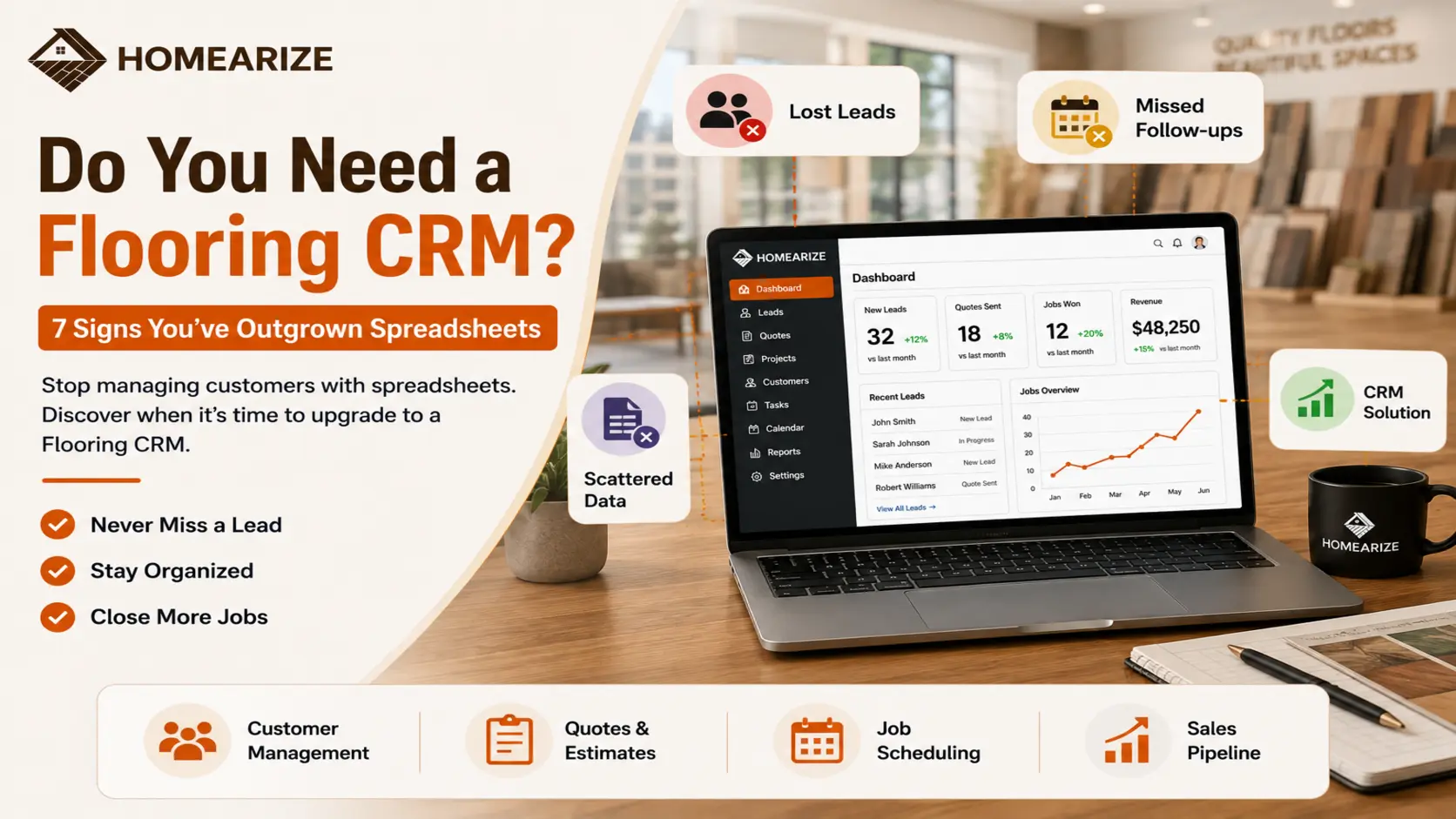
HomeArize was built to close. Instead of stitching together spreadsheets and disconnected tools, HomeArize gives flooring showrooms, retailers, and contractors one system for leads, quotes, scheduling, inventory, and payments, built around how flooring businesses actually operate. You can generate a branded quote in minutes, keep every contractor's schedule in one calendar, and see exactly where a job stands without a single phone call to the office.
If your spreadsheets are starting to feel more like a liability than a system,
book a free demo with HomeArize and see how much easier the day-to-day runs when everything lives in one place.
Highlights
- Spot the 7 warning signs your flooring business has outgrown spreadsheets.
- Compare flooring CRM vs. spreadsheets on speed, visibility, and lost leads.
- See how HomeArize centralizes leads, quotes, scheduling, and payments in one place.
FAQs
What is a flooring CRM, and how is it different from a regular CRM?
A flooring CRM is software built specifically for flooring businesses. Unlike generic CRMs, it includes industry tools like square footage quoting, job costing, contractor scheduling, and inventory tracking.
How do I know if my flooring business has outgrown spreadsheets?
Common signs include missed follow-ups, slow quotes, duplicated work, poor visibility into job status, and growing pains as you add sales reps or crews. Two or more of these means it's time for a CRM.
Is a flooring CRM only useful for large flooring companies?
No. Small and mid-sized contractors often benefit most, since a CRM helps them compete with larger companies by responding to leads faster and staying organized without extra office staff.
What features should I look for in flooring contractor CRM software?
Look for lead tracking, fast quoting, job and project management, contractor scheduling, inventory management, invoicing, and reporting built around flooring workflows, not generic sales pipelines.
Will switching from spreadsheets to a CRM disrupt my current workflow?
Most flooring CRMs, including HomeArize, import your existing customer and lead data quickly, making the transition smoother and faster than most business owners expect.
How does a flooring CRM help with lead management specifically?
It captures every lead in one place, whether from your website, calls, or referrals, and automates follow-up reminders so no inquiry goes unanswered, improving close rates over manual tracking.
How does HomeArize help flooring businesses move off spreadsheets?
HomeArize brings leads, quotes, scheduling, inventory, and payments into one dashboard built for flooring businesses. Your team can send branded quotes in minutes and track every job in real time, without switching between spreadsheets and disconnected tools.
Tags:
Flooring CRMFlooring Business Management SoftwareFlooring Lead ManagementCRM for Flooring BusinessFlooring Contractor SoftwareFlooring CRM vs Spreadsheet