HomeArize
Learn how flooring business management software connects quoting, scheduling, inventory, and commissions into one system, replacing scattered spreadsheets and disconnected tools.
Ultimate Guide to Flooring Business Management Software
There's a specific kind of tired that comes from running a flooring business on spreadsheets. You know the one. It's 8:45 on a Tuesday night, the quote you promised a customer "first thing tomorrow" still isn't done, and you're squinting at a cell that says $4,200 when it should say $2,400. Somewhere a decimal moved. You'll find it eventually, but not before you've lost twenty minutes and some sleep.
Most flooring business owners don't wake up one day and decide they need software. It creeps up on them. First it's a missed callback. Then it's a crew sent to the wrong address because the schedule lived in three different group texts. Then it's a commission check that took two hours to calculate by hand and was still wrong. At some point, the manual system stops being "how we've always done it" and starts being the thing quietly costing you money.
This guide is about what
flooring business management software actually does, which parts of it matter, and how to think about choosing one without getting talked into features you'll never use.
What Flooring Business Management Software Actually Is
Put simply, it's software built for how flooring businesses actually work, not software built for everyone that flooring companies happen to use anyway. There's a real difference. A generic CRM knows how to track a "deal." It has no idea what a waste factor is, or why a remnant of LVT sitting in a warehouse corner matters to your bottom line.
Flooring business management software handles the whole path a job takes: the first measurement, the material selection, the quote, the scheduling, the install, and the payment that comes after. When it's done well, that whole chain lives in one system instead of five disconnected ones that all need the same information typed in separately.
Why So Many Flooring Businesses Are Walking Away From Spreadsheets
Nobody starts with software. Most flooring dealers begin with a notebook, graduate to Excel, and maybe bolt on a CRM that was never designed with square footage in mind. That works, right up until it doesn't. Usually it breaks down around the point you've got two or three crews running at once and a customer list that's outgrown your memory.
A few things tend to show up over and over in businesses still running this way. Quotes take an hour when they should take ten minutes, because someone's manually pulling pricing together. Materials get over-ordered, or worse, under-ordered, because nobody has a real-time read on inventory. Jobs get double-booked because the schedule exists in someone's head, or on a whiteboard that only one person can see. Commissions turn into a monthly ordeal instead of something the system just handles.
The Features That Actually Matter
Not all flooring software is built the same, and it's worth being skeptical of platforms that bolt "flooring" onto a generic template. Here's a breakdown of the pieces that tend to separate real flooring-specific tools from the rest.
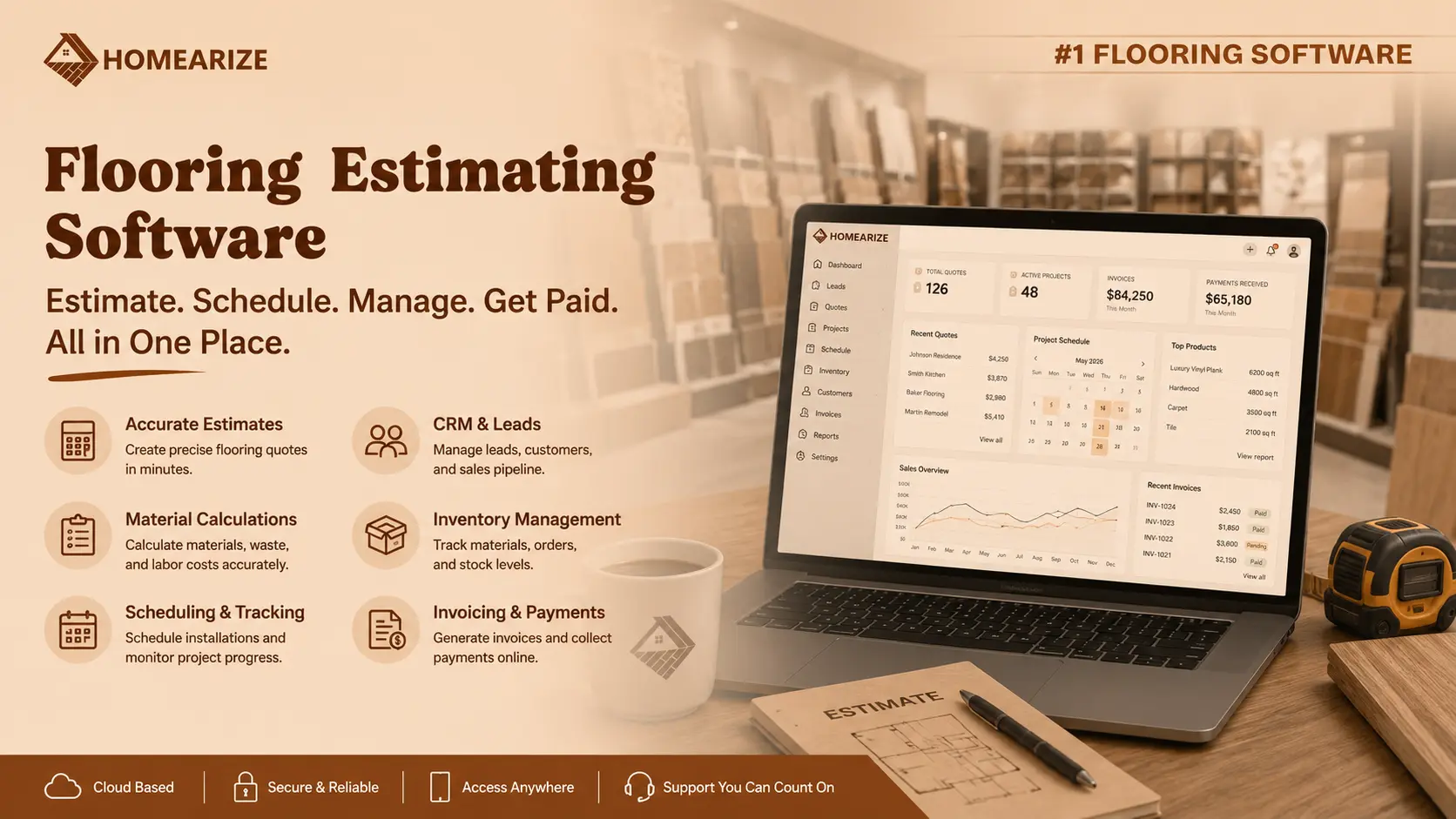
| Feature | What It Does | Why It Matters for Flooring |
|---|
| Flooring CRM Software | Keeps every customer, lead, and job history in one record | Sales teams stop losing leads and can follow up before a competitor does |
| Flooring Estimating Software | Runs material, labor, and waste-factor math automatically | Turns an hour-long quote into a ten-minute one, with fewer pricing mistakes |
| Flooring Scheduling Software | Shows every crew and job on one shared, live calendar | Stops double-booking and keeps installers from showing up to the wrong site |
| Flooring Inventory Management | Tracks stock, remnants, and incoming orders as they change | Prevents over-ordering and stalled jobs from missing material |
| Flooring Customer Management | Holds communication, documents, and payment history per client | Makes service feel consistent, even when different staff handle a customer |
| Commission and Payment Tools | Calculates commissions and collects payments automatically | Cuts out the monthly spreadsheet math and speeds up cash flow |
Put those together and you've got what most people mean by flooring business workflow automation. Instead of quoting in one app, scheduling in another, and chasing payments in a third, it's one connected system. Less retyping, fewer things slipping through the cracks.
What Automation Actually Changes Day to Day
It's worth saying plainly: automation isn't about cutting people. It's about cutting the repetitive parts of the job nobody enjoys doing anyway.
Quoting gets faster first. Instead of manually working out square footage, waste factor, and labor cost, the software does the math while you're still standing in the customer's living room, so the quote can go out before you're even back in the truck.
Scheduling conflicts mostly disappear, because the whole team is looking at the same calendar instead of five different versions of "the plan."
Inventory stops being a guessing game. You know what's on the shelf, what's on backorder, and what's sitting in an installer's van, without walking the warehouse to check.
Follow-ups happen on a schedule instead of "whenever someone remembers," which quietly protects a lot of business that would otherwise go cold.
And commissions, probably everyone's least favorite part of the month, get tied directly to completed jobs instead of a spreadsheet someone has to rebuild every 30 days.
None of these are dramatic on their own. Add them up over a year and they're the difference between a business that can grow without hiring three more office staff, and one that can't.
Choosing Software That Actually Fits Your Business
There isn't a single "best" flooring software, no matter what a comparison page tells you. The right one depends on your team size, how many locations you're running, and how complicated your jobs get. Before you commit to anything, it's worth asking a few blunt questions.
Does it actually handle both the showroom side and the field side, or just one of them while promising the other? Will the pricing still make sense once you add more users or a second location, or does the cost quietly balloon later? Does the estimating logic understand flooring specifically, waste factor and all, or is it a generic project management field wearing a flooring costume? How long does it realistically take to get a team fully onboarded, and is there someone to call when things go sideways? And can it grow with you if you open a second or third location, or will you be migrating everything again in a year?
Pricing transparency matters more here than people give it credit for. A company willing to show its pricing upfront, and let you actually test its calculators before talking to a salesperson, tends to be a company that isn't hiding something. Industry groups like the
World Floor Covering Association also publish standards and training resources worth cross-checking a vendor against, especially if you're new to evaluating flooring-specific technology.
Where HomeArize Fits
HomeArize was built specifically to close that gap for flooring dealers, showrooms, and contractors. Quoting, scheduling, inventory, and commissions live in one connected workflow instead of five tools stitched together with duct tape and hope.
What sets it apart, honestly, is how little it hides. Pricing is public on the site, not locked behind a "contact sales" wall. And there are free calculators for flooring, carpet, margin, and markup that anyone can use right now to see how the numbers actually work, before ever booking a call. For a flooring dealer comparing platforms, being able to test the math yourself before committing to anything is worth more than another feature list.
See It Running on Your Own Numbers
Reading about software only gets you so far. If you want to know whether it actually fits how your business runs, the real test is watching it work against your own quotes, your own jobs, your own inventory.
Book a free demo with HomeArize and see exactly how quoting, scheduling, inventory, and commissions come together in one system. It takes about half an hour, and there's no pressure to switch anything on the spot.
Highlights
- Flooring business management software connects quoting, scheduling, inventory, and commissions into one system, replacing scattered spreadsheets and disconnected tools.
- Automated estimating and scheduling cut quote turnaround from hours to minutes and stop crews from getting double-booked.
- HomeArize helps flooring teams stay accurate and transparent with public pricing, free calculators, and connected inventory and commission tracking.
FAQs
What is flooring business management software?
It's software built specifically for flooring retailers, showrooms, and contractors to handle quoting, scheduling, inventory, customer relationships, and payments in one connected system, instead of juggling spreadsheets and tools that weren't built for the industry.
How is flooring software different from a regular CRM?
A regular CRM tracks contacts and deals, but it has no concept of square footage math, waste factor, or material inventory. Flooring business software combines CRM functions with the estimating, scheduling, and inventory tools flooring jobs actually need.
Is this kind of software worth it for a small flooring company?
Often more so than for a large one. Small businesses tend to feel manual quoting and scheduling the hardest, since it's usually the owner doing it personally. Automating even part of that frees up real hours each week.
Can it handle multiple locations or several crews at once?
Most modern flooring platforms, HomeArize included, are built to scale from one showroom to several locations, with shared scheduling and inventory that everyone can see at once.
Does flooring software help with commissions?
Yes, generally. It ties commission calculations directly to completed jobs, which removes the manual spreadsheet work a lot of flooring businesses are still doing by hand every month.
What does flooring business management software cost?
It varies by platform, usually based on number of users, locations, and features. HomeArize publishes its pricing openly, so you can compare plans without sitting through a sales call first.
Tags:
Flooring Business ManagementFlooring Business Management SoftwareFlooring Business SoftwareFlooring Business AutomationFlooring CRM SoftwareFlooring Estimating SoftwareFlooring Scheduling SoftwareFlooring Inventory ManagementFlooring Software Guide